Optimizations
This section lists optimizations performed by Dr.Jit while tracing code. The examples all use the following import:
>>> from drjit.auto import Int
Vectorization and parallelization
Dr.Jit automatically vectorizes and parallelizes traced code. The implications of these transformations are backend-specific.
Consider the following simple calculation, which squares an integer sequence with 10000 elements.
>>> dr.arange(Int, 10000)**2
[0, 1, 4, .. 9994 skipped .., 99940009, 99960004, 99980001]
On the LLVM backend, vectorization means that generated code uses instruction set extensions such as Intel AVX/AVX2/AVX512, or ARM NEON when they are available. For example, when the machine supports the AVX512 extensions, each machine instruction processes a packet of 16 values, which means that a total of 625 packets need to be evaluated.
The system uses the built-in nanothread thread pool to distribute packets to be processed among the available processor cores. In this simple example, there is not enough work to truly benefit from multi-core parallelism, but this approach pays off in more complex examples.
You can use the functions drjit.thread_count(),
drjit.set_thread_count() to specify the number of threads used for
parallel processing.
On the CUDA backend, the system automatically determines a number of threads that maximize occupancy along with a suitable number of blocks and then launches a parallel program that spreads out over the entire GPU (assuming that there is enough work to do so).
Copy-on-Write
Arrays are reference-counted and use a Copy-on-Write (CoW) strategy. This means that copying an array is cheap since the copy can reference the original array without requiring a device memory copy. The matching variable indices in the example below demonstrate the lack of an actual copy.
>>> a = Int(1, 2, 3)
>>> b = Int(a)        # <- create a copy of 'a'
>>> a.index, b.index
(1, 1)
However, subsequent modification causes this copy to be made.
>>> b[0] = 0
>>> (a.index, b.index)
(1, 2)
This optimization is always active and cannot be disabled.
Constant propagation
Dr.Jit immediately performs arithmetic involving literal constant arrays:
>>> a = Int(4) + Int(5)
>>> a.state
dr.VarState.Literal
In other words, the addition does not become part of the generated device code.
This optimization reduces the size of the generated LLVM/PTX IR and can be
controlled via drjit.JitFlag.ConstantPropagation.
Dead code elimination
When generating code, Dr.Jit excludes unnecessary operations that do not influence arrays evaluated by the kernel. It also removes dead branches in loops and conditional statements.
This optimization is always active and cannot be disabled.
Value numbering
Dr.Jit collapses identical expressions into the same variable (this is safe given the CoW strategy explained above).
>>> a, b = Int(1, 2, 3), Int(4, 5, 6)
>>> c = a + b
>>> d = a + b
>>> c.index == d.index
True
This optimization reduces the size of the generated LLVM/PTX IR and can be
controlled via drjit.JitFlag.ValueNumbering.
Local atomic reduction
Atomic memory operations can be a bottleneck when they encounter write contention, which refers to a situation where many threads attempt to write to the same array element at once.
For example, the following operation causes 1’000’000 threads to write to
a[0].
>>> a = dr.zeros(Int, 10)
>>> dr.scatter_add(target=a, index=dr.zeros(Int, 1000000), value=...)
Since Dr.Jit vectorizes the program during execution, the computation is grouped into packets that typically contain 16 to 32 elements. By locally pre-accumulating the values within each packet and then only performing 31-62K atomic memory operations (instead of 1’000’000), performance can be considerably improved.
This issue is particularly important when automatically differentiating
computation in reverse mode (e.g. drjit.backward()), since
this transformation turns differentiable global memory reads into atomic
scatter-additions. A differentiable scalar read is all it takes to create
such an atomic memory bottleneck.
The following plots illustrate the expected level performance in a microbenchmark that scatters-adds \(10^8\) random integers into a buffer at uniformly distributed positions. The size of the target buffer varies along the horizontal axis. Generally, we expect to see significant contention on the left, since this involves a large number of writes to only a few elements. The behavior of GPU and CPU atomics are somewhat different, hence we look at them in turn starting with the CUDA backend.
The drjit.ReduceMode.Direct strategy generates a plain atomic
operation without additional handling. This generally performs badly except for
two special cases: when writing to a scalar array, the NVIDIA compiler detects
this and performs a specialized optimization (that is, however, quite specific
to this microbenchmark and unlikely to work in general). Towards the right,
there is essentially no contention and multiple writes to the same destination
are unlikely to appear within the same warp, hence
drjit.ReduceMode.Direct outperforms the other methods.
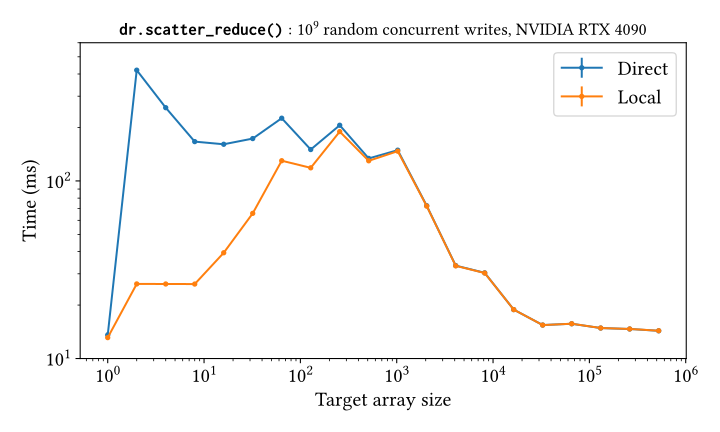

The drjit.ReduceMode.Local strategy in the above plot performs a
butterfly reduction to
locally pre-reduce writes targeting the same region of memory, which
significantly reduces the dangers of atomic memory contention.
On the CPU (LLVM) backend, Direct mode can become so slow that this
essentially breaks the program. The Local strategy is analogous to
the CUDA backend and improves performance by an order of magnitude when many
writes target the same element. In this benchmark, that becomes less likely as
the target array grows, and the optimization becomes ineffective.
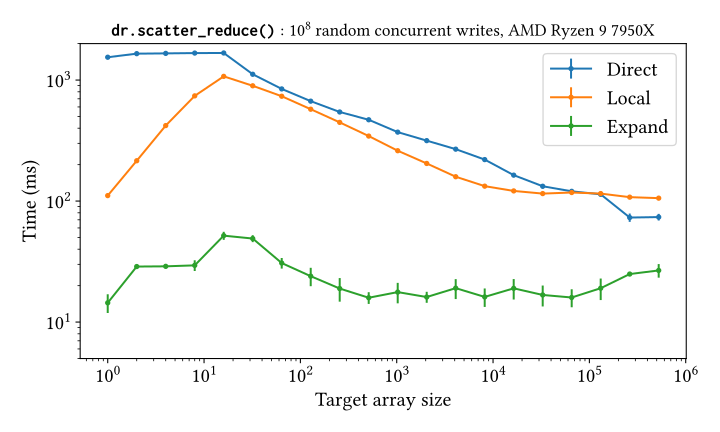

The drjit.ReduceMode.Expand strategy produces a near-flat profile.
It replicates the target array to avoid write conflicts altogether, which
enables the use of non-atomic memory operations. This is significantly faster
but also very memory-intensive, as the storage cost of an 1 MiB array targeted
by a drjit.scatter_reduce() operation now grows to N MiB,
where N is the number of cores. The functions expand_threshold()
and set_expand_threshold() can be used to set thresholds that
determine when Dr.Jit is willing to automatically use this strategy.
Packet memory operations
The functions drjit.gather(), drjit.scatter(), and
drjit.scatter_reduce() can be used to access vectors in a flat array.
For example,
>>> buffer = Float(...)
>>> vec4_out = dr.gather(dtype=Array4f, source=buffer, index=..)
is equivalent to (but more efficient than) four subsequent gathers that access
elements index4*0 to index*4+3. Dr.Jit compiles such operations into
packet memory operations whenever the size of the output array is a power of
two. This yields a small performance improvement on the GPU (on the order of
5-30%) and a massive speedup on the LLVM CPU backend especially for scatters.
See the flag drjit.JitFlag.PacketOps for details.
Other
Some other optimizations are specific to symbolic operations, such as
Please refer the documentation of these flags for details.